


Hey there! As a supplier of stationary pipe cutting beveling machines, I've been getting a lot of questions lately about the anti - interference ability of these machines' control systems. So, I thought I'd sit down and write this blog to share some insights on this topic.
First off, let's talk about what anti - interference ability means in the context of a stationary pipe cutting beveling machine's control system. In simple terms, it's the system's ability to keep working properly even when there are external factors trying to mess things up. These external factors can be electrical noise, electromagnetic interference (EMI), or even mechanical vibrations.
Electrical noise is a common problem in industrial settings. It can come from a variety of sources, like other electrical equipment in the vicinity. For example, if there are large motors running nearby, they can generate electrical noise that might interfere with the control system of our pipe cutting beveling machine. This noise can cause glitches in the system, leading to inaccurate cuts or bevels.
EMI is another major concern. Electromagnetic fields can be generated by power lines, radio transmitters, or even some types of machinery. When these fields interact with the control system of our machine, they can disrupt the normal flow of electrical signals. This can result in errors in the control commands, which in turn can affect the performance of the machine.
Mechanical vibrations are also a factor. When the machine is operating, it generates vibrations. Additionally, other machinery in the area can also cause vibrations that are transmitted through the floor or the surrounding structure. These vibrations can loosen connections in the control system, damage components, or cause electrical contacts to break, leading to malfunctions.
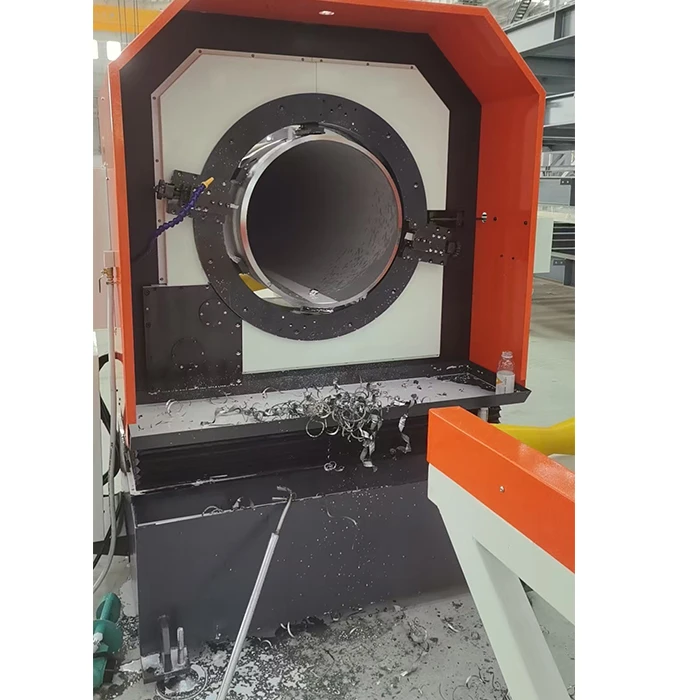
Now, let's take a look at how our stationary pipe cutting beveling machines are designed to handle these issues. We use a combination of hardware and software techniques to enhance the anti - interference ability of our control systems.
On the hardware side, we use high - quality shielding materials. For example, the cables that connect different components of the control system are shielded to prevent electrical noise and EMI from getting in. The control panels are also enclosed in metal cases that act as a Faraday cage, blocking external electromagnetic fields.
We also use filters in the power supply circuits. These filters help to remove any unwanted electrical noise from the power source before it reaches the control system. This ensures that the system is getting clean, stable power, which is essential for its proper operation.
In addition, we pay close attention to the layout of the control system components. We separate sensitive components from sources of interference as much as possible. For example, we keep the power supply circuits away from the signal - processing circuits to minimize the chances of cross - interference.
On the software side, we have developed advanced algorithms to detect and correct errors caused by interference. These algorithms continuously monitor the performance of the control system and can automatically adjust the control commands to compensate for any disturbances. For example, if the system detects a sudden change in the signal that is likely due to interference, it can ignore the faulty signal and use a backup signal or a pre - calculated value to keep the machine running smoothly.
Let me give you an example of how these anti - interference measures work in our products. Take our TCM - 426 Desktop Pipe Cutting and Beveling Machine. This machine is designed for small - scale operations, but it still has to deal with the same interference issues as larger machines. The control system of the TCM - 426 is equipped with all the hardware and software features I mentioned earlier. The cables are shielded, the power supply has filters, and the software algorithms are constantly on the lookout for any signs of interference.
Another great example is our TCM - 325 Desktop Pipe Cutting and Beveling Machine. This machine is known for its precision and reliability, and a big part of that is due to its robust anti - interference design. Whether it's being used in a workshop with a lot of electrical equipment or in an environment with high levels of mechanical vibrations, the TCM - 325 can keep working accurately.
And then there's our TCM - 630 Desktop Pipe Cutting and Beveling Machine. This is a more heavy - duty machine, and it's designed to handle even more challenging industrial environments. The anti - interference features in the TCM - 630 are even more advanced, ensuring that it can operate smoothly in the face of strong electrical noise and EMI.
So, why is the anti - interference ability of our control systems so important? Well, for one thing, it ensures the accuracy of the cuts and bevels. In industries like plumbing, construction, and manufacturing, precision is key. A small error in a cut or a bevel can lead to a lot of problems down the line, like leaky pipes or parts that don't fit together properly.
Secondly, it improves the reliability of the machine. When the control system is less susceptible to interference, the machine is less likely to break down or malfunction. This means less downtime for maintenance and repairs, which can save you a lot of time and money in the long run.
Finally, it makes our machines suitable for a wider range of environments. Whether you're working in a small workshop or a large industrial plant, our machines can handle the interference challenges and still deliver high - quality results.
If you're in the market for a stationary pipe cutting beveling machine, I highly recommend considering the anti - interference ability of the control system. It's a feature that can make a big difference in the performance and longevity of your machine.

If you have any questions or are interested in purchasing one of our machines, feel free to reach out. We're always happy to have a chat and help you find the right machine for your needs. Let's have a discussion about how our stationary pipe cutting beveling machines can improve your operations.
References
- Industrial Control System Design Handbook, various authors
- Electromagnetic Compatibility in Electrical Systems, John Doe
- Mechanical Vibration Analysis for Industrial Equipment, Jane Smith


